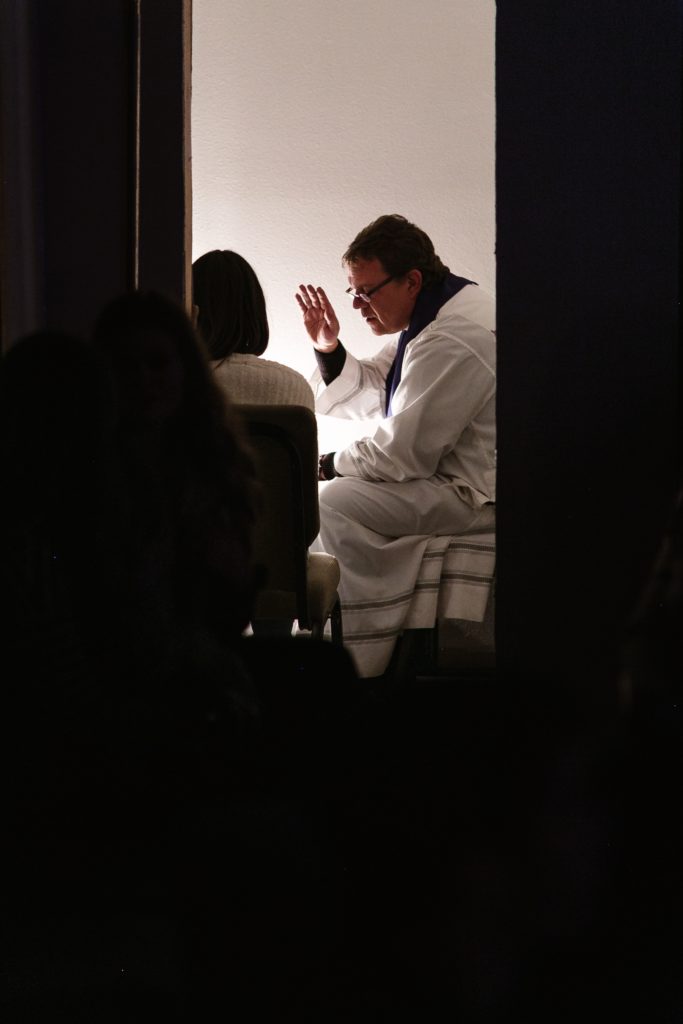
What is the purpose of the sacrament?
If someone was baptized why do they need to be reconciled to God? This question poses some serious responses and these responses are not short. Fortunately, Jesus left the Catholic Church with an answer.
First, full Christian initiation has not taken place until someone receives Baptism, Confirmation and his/her first Eucharist. This is not to say that Baptism alone cannot cleanse a person, but full Christian initiation was added to demonstrate a point. Our new life received in Christian initiation does not abolish the frailty and weakness of human nature nor the inclination to sin due to Original Sin.
The baptized can work to overcome this by the grace of Christ that they may prove themselves in the struggle of Christian life. Yes, that is correct, Christian life is a struggle, not a one time deal of receiving God spiritually and suddenly one’s life is okay. There will always be the temptation to sin and humans will always occasionally succumb to temptation.
Scripture warns us that “If we say we have no sin, we deceive ourselves, and the truth is not in us,” (1 John 1:8). Obviously sin “stains” us or else we would not need a baptism to “wash” us. Since it has been established that we have the ability to sin after baptism or the reception of the Holy spirit and since the Bible tells us that nothing unclean can enter heaven (Revelation 21:27) then that must mean that Jesus left us a way to cleanse ourselves of sin after baptism and before death. This way is the sacrament of Reconciliation and Penance.
Who can administer this sacrament?
Since the power to forgive sins was given to the apostles by the risen Christ (Cf. John 20:21-23) thn the bishops of today’s Church also are entrusted with the ministry of reconciliation (2 Cor. 5:18-20) as successors to the apostles. The bishops and their collaborators, the priests, by virtue of the sacrament of Holy Orders do not forgive sins in and of themselves, but “in the name of the Father, and of the Son, and of the Holy Spirit,” as it is written in 2 Cor. 5:20:
“So we are ambassadors for Christ, as if God were appealing through us. We implore you on behalf of Christ, be reconciled to God.”
What are the effects of this sacrament?
Reconciliation is the act or state of re-establishing friendship between God and a human being, or between two person. When one sins, after baptism, this sacrament is needed to restore one’s relationship with God. Also, since all Christians are connected together through the body of Christ this sacrament reconciles one with the church. Belive it or not, but when one sins not only does one destroy one’s relationship with God, but one also destroys one’s relationship with other Christians. Sin damages or even breaks fraternal communion. This sacrament restores it. In list form the spiritual effects of this sacrament are:
- Reconciliation with God by which the penitent recovers grace;
- Reconciliation with the Church;
- Remission of the eternal punishment incurred by mortal sins;
- Remission, at least in part, of temporal punishments resulting from sin;
- Reace and serenity of conscience, and spiritual consolation;
- An increase of spiritual strength for the Christian battle.
(Catechism of the Catholic Church, paragraph 1496)
What does one do in confession?
The penitent is the one confessing his/her sins and seeking forgiveness. There are three things that the penitent must do for reconciliation with the Lord. The penitent must make an act of contrition and that means to be fully sorry for the sin(s) committed and to firmly resolve that he/she will not sin again. The penitent must confess his/her sins to a priest. The reason for this is given in the answer to question number 2. Also, the penitent must make satisfaction for the sins.
What is the form and matter of this sacrament?
This sacrament’s form is the words of absolution and the matter is the confession of the penitent and his/her penance which is the satisfaction made for the sins.
What is the sacramental seal of confession?
The sacramental seal of confession is that the priest cannot reveal anything told to him, about the confessor, during the confession. There are no exceptions to this rule and the priest is “bound under severe penalties” to uphold this seal. Not even the highest court of any nation has the power top break this for God’s laws are higher than that of anyone else’s.
What is communal celebration and when does it happen?
“In case of grave necessity recourse may be had to a communal celebration of reconciliation with general confession and general absolution. Grave necessity of this sort can arise when there is imminent danger of death without sufficient time for the priest or priests to hear each penitent’s confession. Grave necessity can also exist when, given the number of penitents, there are not enough confessors to hear individual confessions properly in a reasonable time, so that the penitents through no fault of their own would be deprived of sacramental grace or Holy Communion for a long time. In this case, for the absolution to be valid the faithful must have the intention of individually confessing their grave sins in the time required. The diocesan bishop is the judge of whether or not the conditions required for general absolution exist. A large gathering of the faithful on the occasion of major feasts or pilgrimages does not constitute a case of grave necessity.”
(Catechism of the Catholic Church, paragraph 1483)
I am a Jesuit Catholic from birth (being baptized by the church as a infant)
I got baptized in the baptist church as an adult. Not knowing at the time that
Catholics only need to be baptized once. And not told or asked if I was a Catholic.
Did I commit sin?
Thanks
Thanks for another informative site. Where else may I
am getting that kind of info written in such a perfect approach?
I’ve a project that I am simply now working on, and I’ve
been at the glance out for such info.
Excellent article! We will be linking to this
great content on our website. Keep up the good writing.
Hi my name is Elizabeth, and i am from PNG. My First born son will be baptising on the Easter Sunday which is 5th of April. My Husband is not a Catholic but he agreed with me to baptise our Son. my mother in-law is once a catholic but got baptise in a New church and i find it hard to tell her that my son is baptising in Catholic. please help me have the confident and courage to tell her.
Just go ahead and tell her, she has to accept that you want to raise your child in the Catholic Church because that is the decision you and your husband made.
Peace be with you Jon,
I am a convert. I was married (not in the Catholic Church) and received a dissolution of my marriage in 2010. By this time I had fallen away from the Church and remarried in 2012 (hence my now husband was not the cause of the marriage break up). My annulment at present is in process. My now husband and I are in a state of actual grace. My question is: Can we be forgiven of ‘other’ mortal sins in the Sacrament of Confession but not the mortal sin of adultery, or would any of our sins be forgiven in the confessional ‘because’ of the mortal sin of adultery?
This website references (2 Cor. 5:18-20) as an explanation to whom can administer the sacrament of penance as reconciliation. However, it failed to include the most important verse of that chapter.
For God made Christ, who never sinned, to be the offering for our sin, so that we could be made right with God through Christ. (2 Corinthians 5:21 NLT)
The keywords being “Through Christ” not through ANYONE else.
This should be knowledge to those seeking truth on this website.
The power to forgive sins is given by Christ to his apostles and their successors and it is only through Christ’s redemptive suffering and death on the cross that sin is forgiven. This site fully acknowledges that and is the teaching of the Catholic Church.
My mother who is Catholic married a man who is a non Catholic about 20 years ago. She went to confession last night and was told by the priest that he cannot absolve her of her sins. What part of Catholic doctrine says that she cannot be forgiven of her sins?? To me, this is not fair and is a slap in the face to the person who wants to be forgiven. Why let someone live in sin?
Hi Mike. It’s hard for me to say with any certainty since I was not in the confessional. I do know that priests can choose not to give absolution if someone does not seem repentant. Since neither of us were there and do not know what was said, it’s difficult to imagine a scenario like this, but it does happen. Perhaps there was a misunderstanding on the part of the priest. Please encourage your mother not to give up on the sacraments, especially reconciliation and to try again (maybe with a different priest).
Only God can forgive our sins, which makes the sacrament redundant. Why do we need a priest to tell us that are sins are forgiven? If we confess to God our sins then that is surely enough. God may have entrusted the apostles to spread the word, but they are not a neccesary intermediary for forgiveness. If you believe that you need a Priest to help intercede for you in order to have your sins forgiven, you have missed the entire point of Christianity.
You are completely correct in saying that it is only God who forgives sin, this is precisely why it is that the Catholic Church teaches that all priests act “in persona Christi” during this sacrament and others (in the person of Christ). The Catholic priesthood of a Catholic priest is the priesthood of Christ, the Catholic priest’s soul has been adheard to Christ in a unique and indellible way so that it is Christ Himself Who ministers, heals, forgives, baptises, through this priest; it is not just some title, role, or job, the Catholic priest is an extension of Christ’s very own priesthood hear on Earth. And so the sacrament of reconciliation does not then become redundant, the sacrament of reconciliation, like all of the other sacraments, becomes a tangible avenue of God’s grace working for us in the hear and now. He gave us the sacraments, not because they are the only avenues of His grace (the Lord will admister His gifts as He most wills), but these sacraments are the very ways He himself instituted for us to be able to have tangible (physical and spiritual) ways to experience His grace in the community of His Church. The sacrament of reconciliation then becomes God’s gift of He Himself sitting before you, looking you in the eye while you ask for forgiveness, and then having the unspeakable gift of hearing from God himself (in person through the priest) that your sins are forgiven. So it can then been properly understood as a gift, not a redundance….Pretty darn awesome if you ask me 🙂
Yep. The Catechism of the Catholic Church says in paragraph 1446 that, “Christ instituted the sacrament of Penance for all sinful members of his Church: above all for those who, since Baptism, have fallen into grave sin, and have thus lost their baptismal grace and wounded ecclesial communion. It is to them that the sacrament of Penance offers a new possibility to convert and to recover the grace of justification. The Fathers of the Church present this sacrament as “the second plank [of salvation] after the shipwreck which is the loss of grace.””
According to Pope John Paul II the Catechism of the Catholic Church “is given as a sure and authentic reference text for teaching Catholic doctrine.”
I think your comment, “Jesus left the Catholic Church the answer” is unbelievably arrogant. Jesus doesn’t care what “religion” we are, he cares about us as the people he gave his life for. If Catholics do not stop the prideful stance that they have they will be sorry. I think the Catholic Church is in need of prayer.
Hi Cindy. Jesus does care what you believe. He created the Catholic Church from which all other Christian denominations have split. Jesus prayed that we may all be one in the garden in Gethsemane. Jesus did leave the Church the answer and he does care. Peace.