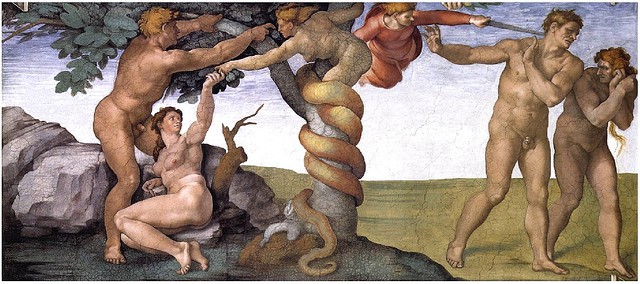
Original Sin is the sin inherited by all humankind from Adam in his disobedience of God’s command not to eat from the fruit of the Tree of Knowledge. The Original Sin event is referred to as “The Fall of Man.”
The Fall
Adam’s choice to disobey God’s command is considered a “fall” because his choice to sin represents a fall from grace. God created Adam in his image and likeness and saw that he was good, (Gen 1:26-31); Adam was created with an original grace and holiness. God shared his entire creation with Adam even giving him dominion over all other creatures and God gave one simple command for Adam to obey:
“The LORD God gave the man this order: You are free to eat from any of the trees of the garden except the tree of knowledge of good and evil. From that tree you shall not eat; when you eat from it you shall die.”
Genesis 2:16-17
Adam and Eve were given the free choice to love and serve God. God gave us the ability to love God freely (free will) because true love is one that is not forced. With this ability to choose, mankind has chosen not to love God, hence our inheritance of a fallen nature.
Adam’s choice to disobey God and eat from the tree in the middle of the garden, after Eve was tempted by the serpent, demonstrated what is at the essence of all sin: that sin is rooted in man’s preference for himself over God. Instead of choosing God, Adam chose himself by eating of the fruit of the tree so that he could be like God, (Genesis 3:5). Humanity was forever changed through this event, losing its innocence of good and evil, bringing sin into the world.
Adam and Eve became aware of sin and its allure and, therefore, more susceptible to sin after having fallen to temptation. Making a choice to sin leads to weakness of the soul and a propensity to continue to sin.
The Nature of Original Sin
Original sin is not a committed sin, but rather a contracted sin. Unlike all other sins, which are acts of one’s own personal sin, it is a state of the soul, representing the fallen nature that was handed on to us by Adam who fell into death upon committing the original sin. It represents the fallen state of humanity in which we find ourselves devoid of the original grace and holiness with which humanity was created, (Genesis 1:31).
Sin not only has personal consequences on one’s own soul, but collective consequences that damage all souls. The Original Sin forever changed humanity by allowing sin to enter the world. Sin is rooted in our preference for ourselves over God. Through the Original Sin humanity took on a fallen nature, one that is incomplete without Jesus’ saving work on the cross.
Christ’s Redemption and Original Sin
The sin of Adam is linked directly to Christ’s redemption; through one man, Adam, sin entered the world, and through one man, Jesus, humanity is restored, (Romans 5:12-21). Jesus is the perfect sacrifice that atones for all of our sins. Jesus, in his complete humanity and complete divinity, is the only sacrifice that could make up for a fallen human nature.
God’s first covenant with humanity, through Adam, was broken through the original sin. God has created a new covenant in Jesus Christ, the perfect sacrifice. Jesus has given us a way to enter into this new covenant, through baptism. Baptism removes original sin and any personal sin, and cleanses the soul making it new and fresh. It makes one a new creature in Christ. God invites into this covenant with him freely and it is up to us to choose to enter into it and uphold our end of the bargain.
It really does not matter who is homosexual or not THE MAIN THING IS TO WORSHIP AND FOLLOW OUR LORD JESUS CHRIST. ALL SAID AND DONE HE AND ONLY HE WILL JUDGE. SO PEOPLE DO NOT WASTE YOUR TIME ON WHAT DOES NOT CONCERN YOU GOD GOT IT COVER!
I am part of the Church of Jesus Christ of Latter-Day Saints. I was confused upon studying the Catholic religion. If we are all born with original sin, and Christ was born into mortality, does that make Christ (until his atoning sacrifice) unfit to dwell in the Father’s Kingdom? After his birth, did he also inherit the consequences of the Fall of Man?
Go to Catholic Catechism, Read from 456-483 (sections, not page numbers). Read all of it.
http://www.vatican.va/archive/ccc_css/archive/catechism/p122a3p1.htm
First the Ten Commandments state that
the children do not inherit the sins of
the fathers. How can we be responsible for
the act of disobedience committed by Adam.
After Adam and Eve partake of the fruit
of the tree of knowledge, Adam and Eve’s
punishment is that the must toil for their
daily bread and Eve having pain during birth.
Adam and Eve were “set up” with Free Will. Who wants someone to love them who is forced to do so??
If a theology can hold beliefs in such things as transubstantiation, virgin birth, and original sin— then it’s easy to see how believers can eventually come to think that eight year old boys can be proper sex partners for adult clergymen. At least pedophilia doesn’t violate all the known laws of biology, chemistry and physics.
Was this supposed to hurt anyone’s feelings ?
The percent of Catholic priests who actually did fall into this unbelievable sin is under 1% of all Catholic priests. There is no other group that comes even close to that small of a percentage, although it isn’t an excuse. We are all sinners. The Catholic Church just takes it on the chin with more frequency because the news media is always looking to crucify Her and will jump at any opening.
A study was done, and it is found that around 50% of all Catholic priests (I forget if it was in America or worldwide) are homosexual. So I don’t think that 1% rating is accurate…
Um, being homosexual and a pedophile are not the same thing. Not sure what your statement has to do with it. Are you saying that homosexuals are pedophiles? SMH.
Very poor logic….makes no sense but I’m sure to you it does.
This comment was made in reply to Bradley.
This is all a bit academic. The Garden of Eden story is fictional (at least in the literal sense) and as such is of no relevance. If the story is symbolic, it is of no use. If it relates to an actual event, that actual event is unknown. The CC accepts the Threoy of Evolutuion and its consequence that the GofE story cannot be (literally) true. Because there are no explanatory notes in the bible, nobody knows or can possible know the actuality that the story refers to. Hence no Original Sin. It can safely be ignored.
A fictional person (Adam) committed a non-existent offence (sin) and was punished by the imposition of a non-existent stain of a non-existent punishment (oroginal sin).
It’s true and we’ve been told by the fathers in the church so it’s true it’s in the holy bible so it’s completely true
Is God not omnipotent and omnipresent? And is He not the Creator? Therefore, did He not know that Adam was fallible and would fall? He created Adam; therefore, he must have known he would choose to disobey Him. And mankind and womankind are doomed forevermore by this “Original Sin”. This does not make sense to me. “I told you not to do it – but you did it – and I knew you would! Because I created you!” It seems Adam was set up to fail. Thoughts?
It seems logical that that is what you’d expect of our Creator, but He didn’t want us to be made to love Him. He wanted us to realize it on our own, hence the free will we were given. Free to do as we wished with His hope that we would love Him. I’m in a Bible study and struggled a little with this myself. A friend’s analogy helped clear it up: her son had his cell phone taken away as punishment, but she did not hide it. She left it out in plain sight. A temptation, if you will. While in the next room, she could hear him checking the phone and noticed that it was not in the exact spot she had left it. He thought he had one over on his mom. Some time later as he related the story to someone, he laughed at his mom’s “duh” moment to the person, thinking she wasn’t too bright to have left the phone where he had access to it. The person he was talking to, older and much wiser, explained the mother left the phone out intentionally to see if the boy would indeed obey his mom (like God had done with the tree and Adam and Eve) because he loved and respected her command, or would he disobey and use the phone behind her back?
I see your point, however. I guess if it were me, I’d make it so they didn’t have that option, but then how would I know if they really loved me or were just doing it because they HAD to? I struggled more with the death part of the whole deal. I finally had it explained today in Bible study.
The mom in your story isn’t what God is – omniscient. Unlike her God must have known in advance that Adam and Eve will disobey him. A test isn’t a test anymore if one knows the outcome beforehand.
Adam and Eve were “set up” with free will. Who wants someone to love you who was forced?!?
Beware of what each brings into the table, least suffering tricks you into supporting it rather than you choosing to cultivate joy, happiness, love. Indeed through one man, Adam, sin entered the world, and through one man, Jesus, humanity is restored: now God has given each the choice to know love and serve God or do something else. What will each choose to do with the present opportunity? What will each soon to bring into this world?
If individuals realized that the original temptation continues to this day and age and it’s up to each individual to choose and follow Love or something else, then they might just appropriately embrace and cultivate love in though-feeling-action. In actuality the choice is between accepting or rejecting love, truth, happiness, this, that and the other things and following through appropriately. Indeed through one’s thoughts actions feelings one brings into the world, love and/or/with something else. God has given each the choice and infinite possibilities choose amongst the better ways now and onward.
Sir,
There seems to be a mistake in your article. You write, “The Original Sin forever changed humanity….” By using capital letters you have identified it as Original Sin which is the “contracted” sin we are all born with because of Adam and Eve. The sin of Adam and Eve might have been the first sin, making it the “original” sin, but Original Sin (capital letters) refers to the sin they passed on to their children. If you had wrote “The original sin (small letters) of Adam and Eve…..” instead, it would have clarified the common misconception that the actual sin they committed is known as “Original Sin”, which it is not.
Thank you, Robert Fitkin