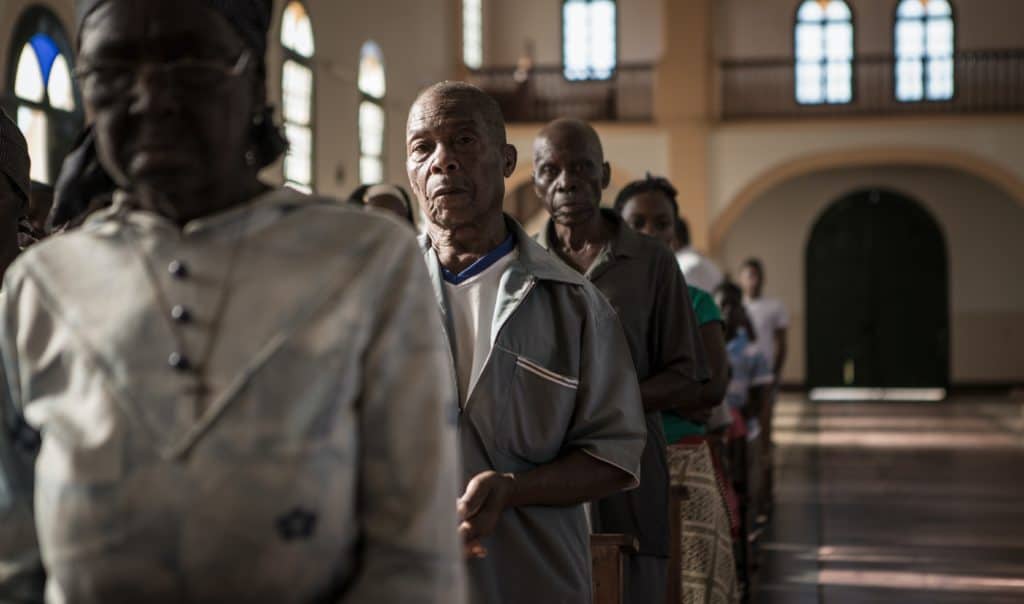
Each and every Sunday over a billion Catholics worldwide are obliged to attend Sunday mass at a parish near them. Why? For starters it is a precept of the Catholic Church, one of the most basic things the Church requires of Catholics. Code of Canon Law # 1247 states:
“On Sundays and other holydays of obligation, the faithful are obliged to participate in the Mass. They are also to abstain from such work or business that would inhibit the worship to be given to God, the joy proper to the Lord’s Day, or the due relaxation of the mind and body.”
Basis in the Ten Commandments
In keeping with Jesus’ instruction to keep the Commandments (Cf. Mt. 22:37, Mk. 12:28-30) and with the authority given to the Church to make decisions that it deems appropriate (Cf. Mt. 16:19, 18:18) the Church has the power to make such rules.
Regarding the Commandments, the Lord told his people to “remember the Sabbath and keep it holy.” In the Jewish tradition this day is Saturday. Jesus sums up the Ten Commandments with two great Commandments in Matthew 22:37 and Mark 12:28-30. In order to demonstrate the point more clearly the text from Matthew’s gospel will be used.
Matthew 22:34-39:
“When the Pharisees heard that he had silenced the Sadducees, they gathered together, and one of them [a scholar of the law] tested him by asking, ‘Teacher, which commandment in the law is the greatest?’ He said to them, ‘You shall love the Lord, your God, with all your heart, with all your soul, and all your mind. This is the greatest and the first commandment. The second is like it: you shall love your neighbor as you love yourself. The whole law and the prophets depend on these two commandments.'”
These 2 commandments that Jesus gave us are 1) based entirely on love (Cf. Rom. 13:9-10) and 2) sum up the Ten Commandments. They are not additions, but they are a summary. The Ten Commandments are found in Exodus 20:2-17. Here it is broken down Commandment by Commandment:
- I, the Lord, am your God. You shall have no other gods before me.
- You shall not take the name of the Lord, your God, in vain.
- Remember to keep holy the Sabbath day.
- Honor your father and your mother.
- You shall not kill.
- You shall not commit adultery.
- You shall not steal.
- You shall not bear false witness against your neighbor.
- You shall not covet your neighbor’s wife.
- You shall not covet anything that belongs to your neighbor.
The Third Commandment
The first three Commandments are summed up with and deal with love of the Lord for these three Commandments deal with the Lord alone. The remaining seven concentrate on offenses to God and man. The focus here is mainly on the first Greatest Commandment and the third of the Ten Commandments. The third Commandment falls under the category of loving the Lord, our God, with all our heart, all our soul, and all our mind. Getting to the point, Jesus basically tells us still to keep the holy the Sabbath day. Let’s take a look more in depth at the third Commandment.
Exodus 20:8-11:
“Remember to keep holy the sabbath day. Six days you may labor, but the seventh day is the sabbath of the Lord, your God. No work may be done then either by you, or your son or daughter, or your male or female slave, or your beast, or by the alien who lives with you. In six days the Lord made the heavens, and the earth, the sea and all that is in them; but on the seventh day he rested. That is why the Lord has blessed the sabbath day and made it holy.”
The words in the Commandment are very explicit as to what the Jews were supposed to do. The Sabbath day was strictly for devotion to the Lord and nothing else should disrupt this observance. In fact the Bible says that not even their beasts may work on that day! This is why this Commandment falls under the category of loving the Lord with all your heart, all your soul, and all your mind. We, just as the Jews, as Jesus said, are to set aside a day for the Lord and devote it to him and worship him. Since all of the Jews had observed on the same day, Saturday, it would make logical sense for the Christians to also gather as a community in a place and worship together in keeping with tradition.
How the Holy Day Became Sunday
The very earliest Christians were converts from Judaism and continued following some Jewish practices. They kept the Sabbath on Saturday and often worshipped in the synagogues. Then they would celebrate their own liturgy on Saturday night (in the ancient world, sundown was the start of a new day, so this would be the start of Sunday) or on Sunday itself. Later, the Christians began primarily celebrating Sunday. Sunday was known as “The Lord’s Day” because it was the day on which Jesus rose from the dead. Therefore, the early Church leaders had changed this observance from Saturday to Sunday in accordance with their power to make such decisions (Cf. Mt. 16:19, 18:18). Holy days of Obligation also fall under this rule of authority.
Benefits of Going to Mass
Whenever God commands us to do something, it is out of love and for our best interest. If this is true (and it is), that means that Mass is good for us.
The Mass brings us in contact with Jesus in four ways (listed here in no particular order):
- Through each other
- In the Scriptures
- In the most holy sacrament of the Eucharist
- Through the priest
We Encounter Jesus Through Each Other
Fellowship with other Christians is important in our life of faith. Our relationship with God is not isolating; rather, it brings us into communion with our fellow human beings. In fact, Jesus even promised, “Where two or three are gathered together in my name, there am I in the midst of them” (Matt 18:20).
We Encounter Jesus in the Scriptures
The Scriptures are proclaimed at every Mass. This is a great way for Catholics to become familiar with the Bible, in addition to praying with Scripture on their own. In countries where many people are illiterate, the Mass may be the only way that these people can encounter Scripture. Because the Bible is inspired by God, we know that God speaks to us through them. Ideally, the homily will help us understand things in the readings that might be difficult to understand.
We Encounter Jesus in the Eucharist
The Eucharist is Jesus Christ: his body, blood, soul, and divinity. On this side of heaven, there is no greater union with Christ than being united to him when we receive the Eucharist. The Eucharist gives us many graces that help us avoid sin and live lives in union with Christ. When we go to Mass, we have the opportunity to receive the Eucharist and experience a union with Christ that is unparalleled.
We Encounter Jesus in the Priest
A priest acts in persona Christi. This means that he acts in the person of Christ. When a priest performs a sacrament, it is Jesus performing the sacrament through the agency of the priest. That means that even if a priest is sinful, when he consecrates the Eucharist, we truly receive the Eucharist. Sometimes people describe it as Jesus “borrowing” the priest’s voice when the priest consecrates the Eucharist. Therefore, we encounter Jesus in the priest, regardless of whether the priest is holy or wicked, and regardless of whether the priest is good at engaging people in participating in the Mass.
Leave this Roman scam called the Roman Catholic Church. The Great Prostitute described in Revelations 17. Walk out of it. Salvation is found in Christ alone. Christ has for once and for all paid for the sins of humanity. You do not need some mass where you receive some Eucharist to be saved from your sins. When Christ instituted the last supper which was again re-affirmed by Paul in 1 Corinthians 11:29, it was to be done in remembrance of what He did for humanity. We cannot replicate the sacrifice of Jesus. It was done once and for all and any form of repetition is an insult to His finished work. The Book of Hebrews was written to explain this. These Roman religion was created by Satan to blind people from the truth. Flee from it before it is too late.
Just would like to alert you that you have crossed out the Second Commandment, most likely a type-o
Thank you so much for the information
What is the Reality, Reflection and Response about this topic””Answer pleace because i need it now…..
So it is my Church ( The Catholic Church ) that demands that we attend Mass on a Sunday, on pain of Mortal Sin. If it is within the power of my Church to impose this rule, then it must also be in the power of my Church to remove this obligation.
The fewer Mortal Sins there are the better. By reason that fewer people will go to Hell. That my Church should continue to insist that Catholics must attend Church on a Sunday – on pain of Mortal Sin – is, to me, Diabolical !
I cannot reconcile my own conscience with this.
That any person should go to Hell on account that that person refused to go to Mass on a particular Sunday in contravention of a Church Rule ? A rule that The Church could change tomorrow, so that less people go to Hell ? See what I mean ?
Going to Mass (or not going to Mass) does not determine whether or not you go to heaven. You’ll go to heaven if you are forgiven of the sins you’ve committed. All you have to do is 1) be sorry for your sins and 2) ask forgiveness. God’s ability to forgive is greater than out ability to sin. That’s why I love confession (I hate it, but I love it at the same time). I hope that’s helpful!
That is very good, it is also very odd and diabolical or demonic to think that a sinful priest could enter into God’s presence and offer up sacrifices for sin. This is not how it was done in the Old Testament and if they are acting in Christ place, who had to be sinless to offer Himself up for our sins, it is totally blasphemous to say a wicked or evil human priest acting in Jesus place could offer up sacrifices for the sins of the world.
Clearly the scriptures teach that 1 Corinthians 1:18 “The preaching of the CROSS is to them that perish foolishness …”
if you are unable to attend Mass due to health or weather conditions would you meet your obligations by watching the Mass on tv?
I broke my foot years ago and a Eucharistic minister came to my apartment when I was unable to walk. I consider going to Mass often a blessing.
Actually I get more out of Mass on TV than in Church
“Therefore, the early Church leaders had changed this observance from Saturday to Sunday in accordance with their power to make such decisions (Cf. Mt. 16:19, 18:18)” How can mere man change what God has ordained concerning the Sabbath day and who gave them[man] this power? The Sabbath was since the creation before there was a Jew or Christian or Gentile etc. It says in Genesis 2:2,3(KJV), “And on the seventh day God ended his work which he had made: and he rested on the seventh day from all his work which he had made. And God blessed the seventh day, and sanctified it: because that in it he had rested from all his work which God created and made.” No where in the Bible does it say we are to observe the first day of the week as the Sabbath. In fact, Jesus himself kept the Sabbath. ” And he came to Nazareth, where he had been brought up: and, as his custom was, he went into the synagogue on the Sabbath day, and stood up for to read.”Luke 4:16(KJV).
Yes early Church Leaders decided to change the observance from Saturday to Sunday, to differentiate the Old Covenant to the New Covenant… not because of men’s decision alone…. we are also commemorating His promise…. remember Jesus Christ said that on the 3rd day He will rise again, and that is the First Day of the week, which is Sunday. Luke 24: 1-10(KJV)
there is only day and night , weeks and months are conventional. what we call the first day becomes the first day . the church looked at the events of , Pentecost and resurrection to choose Sunday . as for who gave them power , its JESUS ‘ whatever you bound on earth is bound in heaven …’
He can’t : (
There is no scripture changing God’s Ten Commandments, (Matt 12; 1-8) Jesus said ” I am Lord of the Sabbath. And in (Matt 5;18) Jesus says “think not that i have come to destroy the law, or the prophets. I have not come to destroy, but to fulfill , for verily I say to you, that not one jot nor tittle shall pass from the law til heaven and earth pass away” ( dotting of an i, or crossing of a t)
i pray by myself everyday. why is it so important to go to mass?
Mass is a celebration of the sacrifice of Jesus. It is public prayer. Praying by yourself is only one part of being a Christian. Praying with the community of believers is another part. As a Christian you one person of many and are called to pray with your brothers and sisters as well as by yourself.
Matthew 6:6 “But thow when thy prayest, go into thy closet, and when thou hast entered thy closet shut the door, Pray to thy Father which is in secret; and thy Father which seeth thee in secret shall reward thee openly.”
According to the Catholic Church the Mass is important because it is how they offer up to God the sacrifices necessary to save the world from sin, Jesus bloody sacrifice on the cross was finished but now YAWN! it must be continued in the un-bloody sacrifice of the Mass, (by which scriptures teach that your sins can not be forgiven Hebrews 9:22 “Without the shedding of blood there is no remission…”) and if you don’t believe and practice everything that we, the Catholic Church, teach you are committing a mortal sin and you will perish. Trust Your ETERNAL SOUL TO JESUS! not the Catholic Church.
To receive Sacraments and participate in Catholic Community.
How does a Catholic start the process of getting his marriage annulled?
Contact your parish priest.
I have been married to a Muslim for 22yrs. l came back to Catholic but since l dont have my baptismal cards l cannot receive Eucharist it really hurts. What must l do?
Are you able to contact your parish of baptism to get your cards or an affidavit?
I think the Eucharist should be given to all humanity. After all, didn’t Jesus spend time with the prostitutes and non-believers or the community? Do you not think that his body and blood was a gift for all those who seek it?