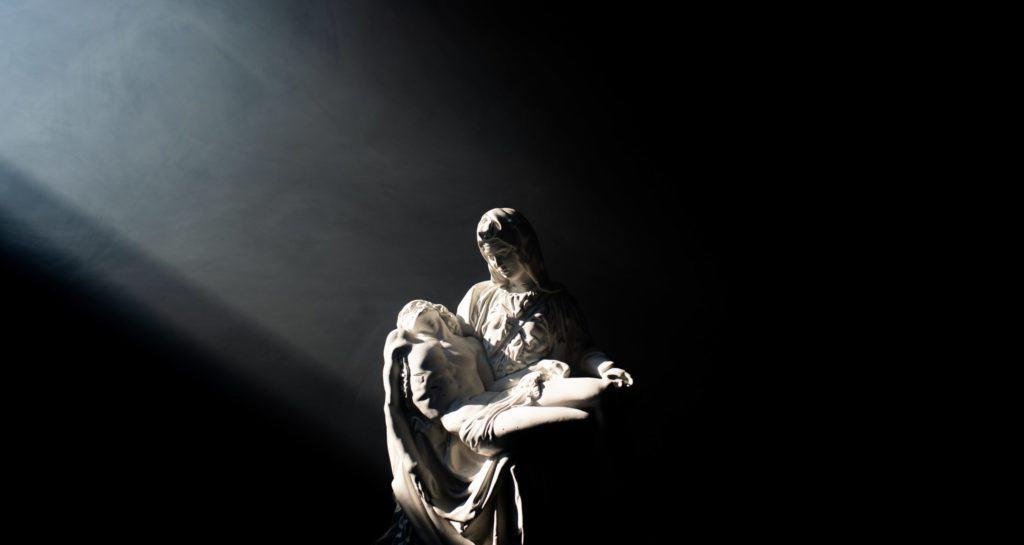
Purgatory is an intermediate state of purification between death and heaven for those who die with venial sins for an amount of time appropriate to the amount and severity of the sins as deemed by God to remove the temporal effects of sin.
It is the final purification so that one’s soul can enter heaven unblemished.
What does Purgatory Mean?
The word purgatory comes from the word purge. It is a ‘place’ to purge the attachment to sin and the temporal effects of sin. Purgatory is often thought to be a place of suffering because it is painful to ‘pay’ for past sins and to give up your attachment to sin. It is also often referred to as a place, however it should really be thought of as a process or state of purification and not a physical location.
Because it is thought of as a place of suffering, purgatory is often used as a colloquial term to mean anything that is difficult or causes suffering. In these cases, it’s not referring to the Catholic doctrine.
Who Goes to Purgatory?
Not everyone who dies goes to purgatory. Those who do make it to purgatory die in the state of grace. They are the children of God, who before death, were guilty of venial sins or have failed to do sufficient penance for sins already forgiven. They may still have some attachment to sin, but they die in a state of friendship with God. Purgatory is not an opportunity where the unrepentant can avoid hell or a last chance to choose heaven. Instead it is a last stop for purification to prepare for heaven.
In Revelation 21:27, God tells us that nothing imperfect can enter heaven.
“but nothing unclean will enter it, nor any[one] who does abominable things or tells lies.”
Only those with no blemishes on their souls immediately enter heaven. Those who have not repented and confessed their mortal sins will go to hell. Seeing as how, when we die, many of us will not fit in either of those two extreme categories we must fit somewhere else, somewhere in the middle called purgatory.
The majority of people are neither so free from sin and attachment to sin as to gain immediate entrance into heaven, nor so attached to sin and unrepentant as to be punished forever in hell.
Those people who have repented and confessed their sins will likely go to purgatory on their way to heaven to be purged removing the temporal effects of sin so that the soul is clean enough to enter heaven. One can reduce the amount of time spent in purgatory by means of an indulgence.
Purgatory is rooted in the Bible. Assurance of salvation and automatic entrance into heaven are not biblical. For if that were true one would have to be as perfect as Jesus, of which no human is capable; you would have to not have the ability to sin.
The Temporal Effects of Sin
This may come off as a strange phrase but it is most easily understood by way of analogy. Let’s say someone shoplifts $100 worth of goods. That person eventually repents returns to the shop owner and asks for forgiveness. The shop owner forgives that person. Everything is good right? Not quite, the shop owner is still out $100. While he has forgiven the shoplifter, he has not been made whole. The repayment of at least $100 is the just temporal punishment for his sin.
Likewise, when we sin we accrue temporal punishment for our sins and often it is not paid before we die.
Everyone is a Sinner
We know that God gave each of us the freedom to sin by giving us free will. Sin is the rejection of God and we can either choose God or reject God even after baptism. Thankfully God offers us the sacrament of Penance and Reconciliation to make right again our relationship with him and purgatory to cleanse us to be in perfect union with him in heaven.
Purgatory is Rooted in God’s Justice
Human justice and divine justice are somewhat similar because our human system is modeled after the divine system. Without the divine justice system we could have no human justice system.
Human justice recognizes big criminals and little criminals and punishes them accordingly. It has a jail to punish some criminals for one, ten, or thirty days, and a prison where it punishes other criminals for several years to lifetimes.
For instance, pretend that in your city two people are arrested, one for speeding and one for murder, and that both people are sentenced to prison for life. Do you consider it just when one who speeds commits a lesser crime than the other who murdered, yet the speeder receives the same punishment as the murderer? Lesser crimes deserve lesser punishment. Denying purgatory is to accuse God of dealing unjustly with his disobedient creatures.
Purgatory is Rooted in God’s Mercy
Purgatory, as a process of purification from sin and from our attachment to sin, is a great expression of God’s mercy. As we have seen, nothing unclean can enter heaven. Purgatory allows us to be clean and capable of entering heaven. Part of what makes heaven heavenly is that everyone in heaven loves perfectly. To be heavenly people, we have to learn to love perfectly.
This means that Purgatory is a mercy of God. It allows us to be purified and enter heaven instead of being barred from entering by venial sins.
Imagine your friend tells you he is going to take you to see someone you love and admire, a famous person whose good opinion would mean everything to you. However, he offers to take you when you had just gotten done cleaning up dog poop and mowing the lawn. You are sweaty, smell bad, and obviously in need of a shower.
Then your friend says, “Here, I’ll give you time to shower, and I’ll make sure you have soap and shampoo and hot water so that you can be clean and presentable when you meet the person you admire.” Wouldn’t that be a great mercy? Even if you know that the person you are meeting will love you anyway, wouldn’t you want to present yourself in a way that shows your profound respect for him? Purgatory allows us to be able to stand before God without shame for the continuing effects of our sin.
Thank God for purgatory! If there were no such thing there would be no path for those of us who are neither the holiest of saints nor enemies of God.
Please do not use typology (The use of pictures without definitive mention in the Bible) Unless it is referred to in the New Testament. Jesus gave us the passages where typology about him is used, so, There is definitive proof in the New Testament. This means that the previously given definition of typology is incorrect therefor taking away Catholic authority which in turn does not allow Catholicism to be correct.
Jesus taught in the gospel that you are to be either hot or cold, and if anyone is lukewarm he will be thrown into the eternal fire of hell. Therefore if purgatory does/did exist, it would be the place where the people are waiting for Heaven to be opened, not a “cleansing process”. Since Jesus already opened Heaven, the “sinless” are already there (ex: Noah, Enoch, Elijah, Job, Daniel, Mary, etc.), while everyone else who will go to heaven is sleeping (dead) until Jesus’ second coming (according to Revelation). The Bible also teaches that intercession is ok, although I am not sure if people who have “gone on” are able to hear us. However, be wary of any apparitions of anything, for 1 John teaches it may be a demon or Satan in disguise. Finally avoid the Beast, the Mark of the Beast, the Illuminati, the Occult, or anything else that involves the worship of Satan.
May God (YHWH) have mercy upon us all! Amen!
There is a philosophy often attributed to the Jesuits’ founder, St. Ignatius of Loyola, that reads along the lines of, “Give me the child until he is seven, and I will mould the man,” or some variation thereof. Regardless of its source, there is much truth to this quote when used to describe those born and “steeped” in the Catholic faith. Many tried and true Catholics, intelligent as they may be, fail to graduate to a higher level of understanding with respect to God’s word. They remain fixed in an inexorable mindset replete with cathechismal dogma they retained in Catholic school or Catholic education classes.
For their own sakes and for the mental health of their children, Catholics might wish to refer to their Catholic bible and consider St. Paul’s words:
When I was a child, I used to talk like a child, and see things as a child does, and think like a child; but now that I have become an adult, I have finished with all childish ways.1 Corinthians 13:11.
There is a philosophy often attributed to the Jesuits’ founder, St. Ignatius of Loyola, that reads along the lines of, “Give me the child until he is seven, and I will mould the man,” or some variation thereof. Regardless of its source, there is much truth to this quote when used to describe those born and “steeped” in the Catholic faith. Many tried and true Catholics, intelligent as they may be, fail to graduate to a higher level of understanding with respect to God’s word. They remain fixed in an inexorable mindset replete with cathechismal dogma they retained in Catholic school or Catholic education classes.
For their own sakes and for the mental health of their children, Catholics might wish to refer to their Catholic bible and consider St. Paul’s words:
When I was a child, I used to talk like a child, and see things as a child does, and think like a child; but now that I have become an adult, I have finished with all childish ways.1 Corinthians 13:11.
Everything must not be stated in the Bible. But let’s face the reality of our daily life most especially on the following:
Why there is prison?
Why people are jailed? and
Why are the jailed people released after sometimes from the jail.
A criminal is jailed to undergo some period of punishment because of the crime s/he committed. The level of crime committed determine your during in prison. People are jailed when they unable to pay the damage they caused. Jailing a criminal serve as a point of correction for the crime committed.
By the other side, for instance, if child of 7 years make an unproper use of his parents’ properties, s/he is flogged even if the child is apologizing. The flogging serve as the punishment for what the child has done so as such mistake should not be repeated again despite the parent has forgiven him for the offense committed.
So when we sin against God, He forgives us but temporal punishment still remain which could be accomplish through our true repentance, good works, prayers, alms-givings, etc and serve as our earthly purification. In exception of these, purgatory is awaiting for us to be purified?
I hope, even if people do not so much believe with the purgatory teaching because of its poor referencing in the Bible, such things could have been as result of omission or considered as a general accepted issues that everyone should be aware of.
I am a Catholic, almost 30 years long. The Bible is the authority. Tradition shall be considered, only if it is in connection with the Bible. Revelation 20 says:
….4 Then I saw thrones, where they took their seats, and on them was conferred the power to give judgement. I saw the souls of all who had been beheaded for having witnessed for Jesus and for having preached God’s word, and those who refused to worship the beast or his statue and would not accept the brandmark on their foreheads or hands; they came to life, and reigned with Christ for a thousand years.
5 The rest of the dead did not come to life until the thousand years were over; this is the first resurrection.
6 Blessed and holy are those who share in the first resurrection; the second death has no power over them but they will be priests of God and of Christ and reign with him for a thousand years.
7 When the thousand years are over, Satan will be released from his prison
8 and will come out to lead astray all the nations in the four quarters of the earth, Gog and Magog, and mobilise them for war, his armies being as many as the sands of the sea.
9 They came swarming over the entire country and besieged the camp of the saints, which is the beloved City. But fire rained down on them from heaven and consumed them.
10 Then the devil, who led them astray, was hurled into the lake of fire and sulphur, where the beast and the false prophet are, and their torture will not come to an end, day or night, for ever and ever.
11 Then I saw a great white throne and the One who was sitting on it. In his presence, earth and sky vanished, leaving no trace.
12 I saw the dead, great and small alike, standing in front of his throne while the books lay open. And another book was opened, which is the book of life, and the dead were judged from what was written in the books, as their deeds deserved.
13 The sea gave up all the dead who were in it;
14 Death and Hades were emptied of the dead that were in them; and every one was judged as his deeds deserved. Then Death and Hades were hurled into the burning lake. This burning lake is the second death;
15 and anybody whose name could not be found written in the book of life was hurled into the burning lake.
This is the Truth, all the rest are “may be”, ” probably”, etc.
and by the way:
Jesus shall reign 1000 years in Jerusalem (..entire country and besieged the camp of the saints, which is the beloved City…). Going to Heaven is a bit different, that what is saying here.
We pray every:
… Thou Kingdom come …
not let me come to Your Kingdom in Heaven.
It’s just obvious that some people misread and misunderstood what the scriptures is saying, all for the sake of argument. St Paul termed this kind of humans ” heretical Christians” while writing to Timothy( 1Tim 6:20), ‘ Paul warned him to keep safe what has been entrusted to your care. Avoid the profane talk and foolish arguments of what some people call knowledge. For some have claimed to possess it, and as a result they have lost the way of faith. Am a catholic, am proud of catholic, forever will i be a catholic. Yep, i read some text, people saying books of maccabees had been rejected! Now explain to me why it was rejected by some churches except Catholic who called it to be among the deutrocanonical books. All these resulted from your great grand fathers Martin Luther and his colleagues. If purgatory doesn’t exist then what was john telling us in Rev21:27, ” God said nothing imperfect, nothing unclean shall enter the kingdom of God. Some scriptural passages said your work shall be tested as if passing through furnace. John also attested to the fact that the bible doesn’t contain everything that happened. He who has ear let him hear, that was the word of Jesus. Thanks, for more details you can email me @ alabidallas@gmail. Com
When I was a little kid I was so scared to do my first confession because I thought the penance was going to be something really tough, like reading the entire Bible or fasting for a week. Haha, I was very wrong 😉
We have no way of currently knowing, but perhaps purgatory “isn’t that bad”. Maybe you just have to say a couple Hail Mary’s and then you’re welcomed into heaven 😉
Are you kidding. Jesus purges to the utmost. He accomplished that on the cross and in His resurrection. Your Catholic purgatory does not exist. The Bible says He purges to the utmost Heb 1.
So God purges but there is no purgatory… hahaha
John 3:16New International Version (NIV)
16 For God so loved the world that he gave his one and only Son, that whoever believes in him shall not perish but have eternal life
There is NO purgatory! It is either you go to hell or go to heaven. All you need is to have faith in Jesus to be saved. Thank you Sue for mentioning the story of the thief on the cross. This is a proof that you only need faith in Him to be able to go to heaven. Did the thief followed the 10 commandments? NO! Did he do good works? NO! All he did was believed in Jesus and he was saved. Now if you believe you have faith in Jesus, you shall live and try to be like Him. You have to love your neighbor as you love yourself and this is His commandment. And of course His greatest commandment is to ‘Love the Lord your God with all your heart and with all your soul and with all your mind.’ This is the first and greatest commandment. Please email me at [email protected] if you are confused. Glory be to God!!!
Are you Catholic? It doesn’t sound like.
Dennis that’s exactly what I thought while reading the above article. When the author wrote about the person being “clean enough to enter heaven.” What??? The blood of Jesus washes us clean when there is repentance. We will all (religions and nations) go straight to heaven to face the judgement seat. John 12:48. The sobering fact (Word of God) is that once we stand before our Creator, it is too late for a do-over. I hope (and will be in prayer about) what the author believes and teaches others comes solely from the Word of God and not a mere human.
If what you say is true, then Jesus must be a liar. Among the MANY things he said was something like : those who entered the kingdom of heaven would NOT be those who cried “Lord, Lord” but those who DID the will of His Father. This indicates a necessary response on our part that surpasses simply saying “Lord, Lord”.
If we look at the Bible in pieces we can misunderstand what God wants us to know. The ‘Doing’ part of our faith is told also in Romans 8, “if you believe in your heart AND confess with your mouth you will be saved”. Saying ‘Lord, Lord’…the verses you refer to are speaking about people who did believe in their hearts. Please read the surrounding context.
Catholic sacraments and beliefs about purgatory did not come about until around 13th century. Early Christians around the world did not practice these things. Were they not saved?
Personally , I think there has been a misunderstanding regarding pergatory/no pergatory. I have to agree with John 3:16 as we all do . Because of Jesus’ sacrifice , HE paid the penalty for all sins and we are forgiven, that means we are fully cleansed and have no sin applied to us. When we die , we are rewarded ” Eternal Life” through Christ who is in us. It is by believing in Christ that we are justified and declared innocent from sin and are saved. We are awarded the “Crown of Life” Since ” good works” are a result of salvation. Then ” good works” are rewarded with jewels in our crown . Some people will have many jewels in their crown and some will have none. Only Jesus saved us from sin and death. Other peoples prayers can never do that. We are rewarded with jewels in our crown of life in Heaven . When Jesus died , He said , ” IT IS FINISHED “
Jesus has paid the ultimate price and yet we still have the free will…. we still sin right? for no man is as perfect as Jesus! why then will john say nothing impure would enter into heaven? was he drunk? we are all impure! so I guess there’s no hope for us since we still sin even after Jesus died. glory to God the thief repented and died under grace…. now tell me how many of us would died as clean as he. think twice people
So Robert Sturey, that would mean every person no matter how bad goes to heaven. I guess I will just do as I please and make myself happy, do nothing but party and commit as much sin as I want because I am going to heaven.
Thanks for that Robert. It is finished. Over. Leave this life and step into heaven. I will see all of you there.
Thank you! I am an ex Catholic. .. I was raised to believe in purgatory. I was raised to pray the rosary. I was raised to pray for the souls in purgatory. And even then it never made sense to me. If Jesus died for our sins, why would we still need to be purified? We don’t. There is no purgatory. And heres another thing: people, please stop praying to Mary. She cannot hear you. All the prayers that you pray to Mary go unheard. She was a sinner people….Yes, she was blessed and chosen to carry Jesus, and YES, she found favor with God. But she was still a sinner. Where the Catholics came up with the idea that she was born without sin is insane. And completely unfounded in scripture.
And please tell me anywhere in scripture where it says Mary was taken bodily up to heaven……
There is only one mediator between God and man. And that is Jesus Christ. Not Mary. I think the Catholics put way too much emphasis on the mother of our savior , instead of on our savior where emphasis belongs.
lol….young woman! yet you tell your pastor to pray for you and tell you late grand ma to watch over you from heaven….. hypocrisy! I pray for Mary to intercede for me, she’s d mother of my saviour but not bigger than God…. you should have researched well before you left the church
Yes, I can ask a human being to pray for me.
That is not the same as praying to a saint requesting their prayers. In order for mary to be aware of everyone’s prayers to her she would need to have the qualities of God. She would need to know your thoughts, your heart, your mind, and be in all places at all times as ppl across the world pray to her. According to scriptures those qualities belong to God alone.
Also the most popular verse that catholics like to use to prove the saints hear our prayers is in revalation 5: 8 where our prayers are brought up to God by the saints. But if you read carefully it’s not the saints who collect these prayers it’s the 24 elders and the 4 living creatures. Why do the catholics like the sneak the word saint in there? It never said saints. If I were to use the logic of catholics then I could pray to st. John, to paul and to any saint for that matter. No where do we see this in scripture. The only thing you see in scriptures are prayers dedicated to God alone! Yes we clearly see paul asking for prayers and thoughts and he did so too, but again he never prayed to anyone other than God and he didn’t request intercession of saints that have left this earth. And if mary was sinless why would she call Jesus her savior? She also referred to herself a servant. Mary did not exalt herself nor did Jesus exalt her when mary was looking for jesus in the crowd and he said who is my mother? These are all my brothers and mothers!
So now Mary is not a human being? Your logic is flawed and like so many you do not want to know the truth because if you did it would mean change and that’s painful. You insist on isolating a few quotations from scripture and insisting that that’s all there is. How about reading the end of Matthew for starters.
i know people that have used murder as purgatory and got a ;letter from the holly father relieving them
from this horrid crime.
Who is this person? Can you really be so ignorant or are you just happy to use whatever nonsense floats your way to justify your position?
I am not really sure but I think the thief went straight to heaven because he got a chance to as for forgiveness and be cleansed just before his death.
So do we go to purgatory then heaven
if it is murder you go to the penn and die.
Thank you for taking the time to post these great, informative, insightful – beautiful readings. I am Catholic and truly love and believe mu faith. I am 43 years old and married wirh a Catholic. However, in my mid-twenties for sbout 5 years I was tested and challenged about my faith. I dated a Lutheran. It was not easy and in trying to convert him, I ended up converting myself (bu God’s will and grace) into a more knowledgable Carholic. I loved my faith back then but now I live for for it and follow it. People like you help individuals like me lesrn more and explain it to others. Thank you from the bottom of my heart because you don’t know who is in the path to conversion – even if they don’t know it.
Thank you for your kind words, you are very welcome.
do your best and GOD will do the rest,who are we to judge,i respect all the comments mentioned but jesus is a loving man and believe it or not will not punish those who make the odd mistake in life, he who live without sin cast the first stone,every single person on this earth has there own understanding of god,life and how they should live it, choices are as simple,GOOD v EVIL,,as for purgratory,as long as i have a slim chance of gaining a passport to heaven to meet up with all my ancestors n MARY the Queen of heaven n saints ,cant wait,
John, your first article is great. But I do like the second also. Just recently I was talking with an evangelical about a need for purgatory and where is it mentioned in the bible. My answer cannot be long winded, even though a good answer, because in a conversation like this topic, oftentimes it is difficult to just listen while the other talks. Repeating a statement oftentimes will make the other just stop and think, giving pause to let a thought(s) penetrate before pressing on. Good job, John. Thanks.
For me I believe somuch in the” purification of sin after death”, which is also known as “purgatory” whether it is found in the scripture or not but to clear any doubth.. It is in the bible 2maccabees 12:45 or 1corinthians 3:10-15. I think these verses explains better about cleansing of sin after death. May the Lord open our hearts to understand the scripture beter.
the are many souls in pugatory that are waiting for people please let take the task and pray for them they can help them self only we can pray for them they are are helpless just say the rosary or any other prayer may the good lord bless all those who are prayeing for the soul in pugatory
1 Corinthians 3:10-15 has nothing to do with going to hell or purgatory. It’s talking about Christ seat of judgement (Re 22:12) also stated in 2 Corinthians 5:10-” For we must appear before the judgement seat of Christ.”…
Purgatory is non-biblical. Satan is a liar, and a father of it. Paul himself stated in Philippians 1:21-23-…”having a desire to depart, and to be with Christ”…..
And we can’t pray for people who died, Hebrews 9:27-” And as it is appointed unto men once to die, but after this judgement”.
When we die, we immediately face God and are judged for how we live our lives either with or without Jesus. Once God makes His judgement in us, no one can pray us out of hell, if that was true, Jesus didn’t have to die.
John 3:16-” For God so loved the world that He gave His only begotten Son, that who shalt ever believe on Him, shall ” NOT PERISH” but have everlasting life”
It does not say anything about purgatory, or having your loved ones praying for you to come out of hell.
Amen! 100% agree.
A Catholic relative of mine gave each of her children a small book called “Within the Gates” some time before she died of cancer. And her daughter gave me the same book sometime after. It was written a century ago by a woman who was very ill waiting for her family to come to her…they were far away & I assume travel was difficult in those days. She prayed for comfort in her misery and soon she had a vision. Her dead brother in law appeared and took her on a visit to the Heavenly City of God. This woman was unconscious a matter of days while the vision covers a period of years. It seems like a divine drama given in sketches like an allegory.
I’ll only speak to the beginning which seems to have a likeness to Purgatory…only much more acceptable to those of other Christian churches. She must have slept on the trip but awakened in a sheltered nook surrounded by magnificent flowering shrubs and the softest most beautiful grass. Everything was perfect. Looking ahead she saw a wonderful swirl of grass and flowers with equally wonderful trees whose branches were laden with blossoms and fruits. She found herself thinking of St john on the Isle of Patmos, and the tree of life that grew in the midst of the garden bearing “twelve manner of fruits for healing of the nations.” Beneath the trees in many happy groups, were little children laughing and playing in their joy. All through the grounds, older people were walking in groups, or two’s or alone, but all with an air of peacefulness and happiness that made itself felt by her, a stranger in their midst. All were in spotless white with many carrying clusters of beautiful flowers. As she looked upon their happy faces and their spotless robes, she thought…”These are they…which have washed their robes, and made them white in the blood of the Lamb.”
Leaving out several lines about elegant homes off in the distance she also saw a river flowing by her with water as clear as crystal. Walks ran in many directions and found to be made of pearl, spotless & pure bordered by narrow water streams running over stones of gold. All she could think was …purity. Instead of sunlight there was a golden, rosy glow everywhere. Finally she looked up and heard her brother say softly, “Well?” She realized he was watching her with keen enjoyment. She would have answered but then, such an overpowering sense of unworthiness poured over her that she dropped her face into her hands, and burst into uncontrollable and very human weeping.
Her brother lifted her gently to her feet and said, “Come, I want to show you the river.” When they reached the bank of this lovely river only a few short steps away, her brother stepped into the water, urging her to do the same. She drew back fearing it was cold but he said not in the least, smiled and said, Come. Just as I am? Just as you are, he said, with a reassuring smile. Encouraged she stepped into the gently flowing river. She found the water in both temperature and density almost identical with the air. She went deeper & deeper & was afraid to go over her head for she wouldn’t be able to breathe & suffocate. Her brother said, with an amused twinkle in his eye, ” we do not do those things here.” Realizing the absurdity she plunged below the water. To her delight she found she could not only breathe but laugh & talk and hear as above the water. As they prepared to leave the water she thought what would they do for towels in her earthly mind. As they came out of the water there was no need…she was completely dry, as before. She had been given a robe fashioned as she had never seen…soft , light and shone with a faint lustre reminding her of silk crepe. The water seemed to make it more lustrous than before. As they walked on a few steps, she asked her brother, “What has the water done for me?”
She felt as though she could fly. He looked at me with earnest, tender eyes as he answered gently. “It has washed away the last of your earthly life and fitted you for the new life into which you have entered.” It is divine and he said, “yes it is divine.” And on and on this beautiful story goes.
I am a Catholic but have strayed in the past into the non-denominational world. After a rather tragic life experience many years ago, I continued to believe, thanks to 14 years of Catholic schools, but I lost my trust in God. For 10 years I was on my own with no faith that God could help…He hadn’t in the past. But I continued to search for answers. Finally with the prayers of many I had a true conversion experience…giving up my will for His. No voices or visions but the scales were removed and I knew that I knew that I knew…in a way I had never known in all my life. I truly felt like St Paul on the rode to Damascus…and there were many litle miracles assuring me I had made the right choice in the next few weeks. Fortunately or unfortunately this happened through the prayer of friends…some had been formerly Catholic and some never Catholic. The joy I felt and still have, led me to read and study learning so much that all my schooling had never taught. My story is a long one but suffice to say I am back to the Catholic church but having struggles with teachings and disappointment in the Catholics and the priests. I’m sure there probably are Catholic parishes much better than mineI I remember reading Scott Hahn and others like him & their disappointment in the faithful! I believe in all the major tenants of the church but several things give me trouble. I stumbled on your writings & read all on purgatory and your thoughts of what others may believe. You don’t mention that those others are well aware of their imperfections/sins but those who walk with Jesus pray for forgiveness daily as they are less than they would like to be..as St Paul said. And surely if they have the opportunity of a death bed time would be praying for forgiveness for their venial sins in Catholic vernacular…and if not, have prayed each day for forgiveness should they be taken suddenly. Not sure the vs you site are enough for my belief…must a catholic believe that?
Whether this vision is truly from God, no one knows but it explains beautifully the grace of God for those who have tried their best to walk with Jesus. Who am I to say what is truth but when you read the way Jesus conducted His life the three years of His ministry on earth, this seems so much more fitting.
I am drawn back to the Mass as there is something missing, as you well know, in other churches…but at the same time there is a joy in many of those churches which is not present in the Catholic church…and their biblical sermons are truly stirring & actually teach! Their Bible studies and their youth groups are thriving. I attended Mass with my son’s family in the gym (not my choice) due to the crowds., they said. It was quite honestly the worst homily I have ever heard on an Easter morning! No wonder we are losing our Catholic young people! I am convinced the majority of Catholics do not know what it is they believe…have not had a re-conversion…have no desire to understand how the Old Testament connects to the new T. They just follow the rules & expect that is all they need. Many I know did not even take the time to watch the recent Bible story on Sunday evenings.
I started this search because we had lunch a few days ago with two Catholic friends..a couple and a widow both in their 80’s. Somehow our conversation arrived at what you must believe to have entrance to heaven. They both said, a good man, with no belief in God, no faith can go to heaven. I was shocked! I quietly explained we just had Good Friday… what was the purpose? If any “good” man can go to heaven without believing in Jesus …then we are all on a path to nowhere. And pointed out “no man is good, no not one” and on and on. If just believing and Sunday Mass with little knowledge is all that is necessary then they may squeak through the cracks of the Pearly Gates. They are missing so much!
Sorry to go on & on…wish I could wave a heavenly wand and bring all these people to the most important belief in their lives! Instead I’ll pray! I know nothing is too great for God…but He has His work cut out for Him leading all these people to a saving knowledge of Jesus! And I’m not sure His priests are helping one bit…we need a thousand + Fulton Sheen’s!
Thank you so much for the post. Very beautiful and inspiring. I too feel that scales have been removed. I was so very blind before, when nothing about scripture made sense. And now, after years of prayer, suddenly scripture is different and revealing in such a beautiful way. All thanks and praise be to GOD.
You are so full of it.
Put your faith in Jesus’ saving blood sacrifice and in His resurrection.
I do not judge your beleif in purgatory, but Jesus came so that through Him, He died for our sins. When we accept Him as our Lord and Savior, we do not need a go between between us and God. Hense, in my humble opinion, there is no need in Purgatory, as Jesus has made the ulrimate sacrifice, now it is up to us to accept Him and try, because try is all we can do, and we usually fail, but because of God’s grace, we are accepted into Heaven, without the need of purgatory. I will not argue the Bible, so I expect to see Catholics, Methodists, all Christians in heaven. May God bless us all.
Thank you, Susan. Purgatory is not a go-between. Purgatory exists because of Jesus’s sacrifice on the cross. Salvation is a journey made possible by Christ. If you believe that accepting Jesus Christ cleanses you of all sin and you are assured of your salvation, then Purgatory does not make sense. However, this belief is not what the Bible teaches nor is it the faith handed down through the centuries from the apostles and Jesus Christ himself. Salvation is a process beginning with the redemption offered by Christ and our free acceptance of his redemption. Christ’s sacrifice on the cross makes it possible for us to be saved, but we must accept Christ in all that we believe and do throughout our life. We might sin, even after accepting his redemption, and thus damage our relationship with God. Salvation is not assured when you can fall out of favor with God through sin. Thankfully god offers forgiveness for those sins. Jesus’s sacrifice on the cross makes reparation for our sins and makes it possible for us to have forgiveness for them and be cleansed through purgatory on our way to heaven.
I respect your thoughts, and faith, but please – show me where the apostles or Jesus taught anything about purgatory. Macabee’s is rejected as cannon by every faith except Catholicism, Orthodox and Coptic Christianity. Jesus, nor his apostoles, ever mentioned purgatory or anything of the sort. Revelation is sketchy ground, as to me, it’s clear to see the Whore of Revelation is the Roman Church and the harlots are all the branches that have come from it.
Jesus taught that it would be easier for a camel to pass through the eye of a needle than for a rich man to get into heaven. He also taught to identify false prophets, you judge a fig tree by the fruit it bears. I don’t think the HRCC is sitting too pretty here.
Not trying to deamonize any individual, or their beliefs, but interested in hearing from believers why they haven’t sold everything they own and live a life of poverty as Jesus taught would be necessary to enter his Fathers kingdom. Seems like Purgatory is a ‘get out of jail free’ pass for those who don’t live the way Christ taught, including the Church.
I am NOT a Catholic but I do remember Jesus saying to the thief on the cross… this day you will be in paradise with me. What is the difference between paradise and heaven?
If you trust the New Testament is the correct books out of all the other books that could of been chosen, then you accept the authority of the Catholic Church. To remove books to fit your “theology” is fallacy. In case with Maccabees. Luther removed because of his opinion and pride.
Jesus saving blood sacrifice does not open up purgatory.
His saving blood sacrifice opens up heaven.
Doesn’t your church tell you that Jesus purges us from all sin? Doesn’t your Church tell you to read the Bible?
Your church has lied to you about purgatory, your church wants you to put all your faith in purgatory so you will continue giving money to your church so your money making papacy can get people out of purgatory. LOL
Jesus said to the thief on the cross, today you will be with me in paradise, He didn’t say, today you will be with me in purgatory. Jesus is not in purgatory, He is in heaven, paradise and heaven are the same place. The truth is you Catholics don’t believe in Jesus saving blood sacrifice. You would rather go to purgatory and hopefully get purged there instead of believing in His saving blood sacrifice.
Jesus did not open up purgatory on the cross He opened up heaven on the cross. Jesus is in heaven not purgatory. Jesus told the thief on the cross you will be with me in paradise, not in purgatory. At the Lord’s supper Jesus said my blood will be poured out for the forgiveness of sin, He never said His blood will be poured out to open up purgatory, He never said my blood will be poured out to save those on purgatory. The thief on the cross went to heaven not to purgatory, because purgatory does not exist.
Heaven and paradise are the same place.
Heaven exists because of Jesus saving blood sacrifice. Heaven and paradise are the same place. Purgatory is not paradise, Jesus did not open up purgatory, purgatory does not exist. Jesus is in heaven not in purgatory with the thief, Jesus is not a sinner. The thief is in heaven with Jesus. Jesus said to the thief on the cross, today you will be with me in paradise, Jesus didn’t say purgatory.